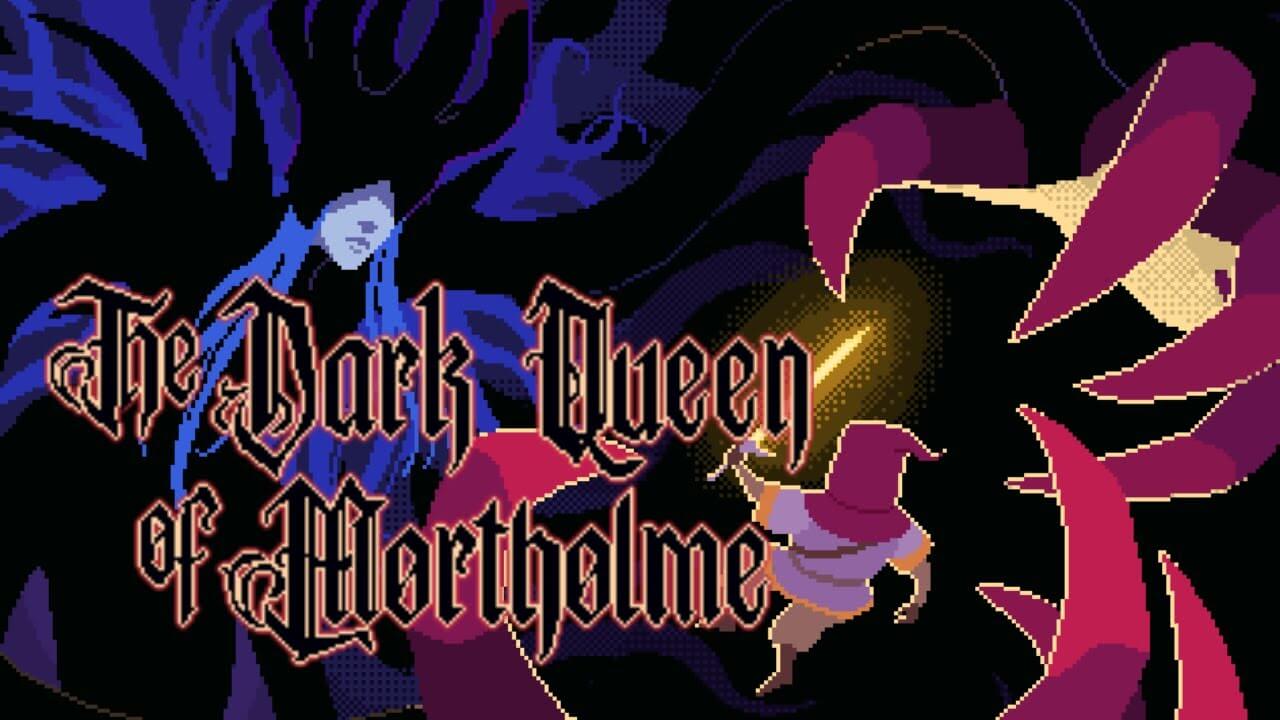
News: The Dark Queen of Mortholme - Exploring choice in a world that barely moves
✪ Be The Villain
I’ve always been drawn to games that poke at the edges of their own format-those odd,
meta-leaning experiments that nudge players to reconsider what “winning” or “progress”
even means.
The Dark Queen of Mortholme
fits neatly into that lineage: a short, indie experience that invites you to inhabit the
so-called villain and challenges you to question the reflexes you’ve internalized over years
of traditional game logic.

But as I spent time with it, I found myself wrestling with an unexpected tension. The game clearly wants to flip established patterns, yet it often hesitates between intent and execution. And as a result, I was frequently unsure whether my actions were feeding into the design or simply drifting in a space the developer hadn’t fully mapped out.

✪ Playing with Expectations
The game’s core premise immediately brings to mind other titles that explore the idea that
defeating an opponent isn’t equivalent to “winning.” Slay the Princess, for example, built
its entire visual-novel structure around questioning the meaning of choice, pushing players
to confront the weight of intention within a clearly story-driven frame. That format naturally
supports nuance; narrative branches make sense when every line of dialogue can shift the tone.

The Dark Queen of Mortholme, by contrast, operates in a more action-oriented shell. Attacking or not attacking doesn’t always correspond to narrative consequences, and the game often obscures whether it’s reacting to what I do or simply letting time pass. In my first playthrough, I allowed the hero to strike me repeatedly without retaliating. Nothing happened. No commentary, no shift, no acknowledgment. Then, in my second run, staying still a little longer prompted the hero to ask why I wasn’t moving. Was that delay really meaningful?

✪ The Burden of Subversion
Undertale inevitably comes to mind when discussing games that deliberately undermine player
habits. Its pacifist route works because the mechanics and narrative reinforce each other;
every confrontation is a moral decision, and one accidental kill genuinely matters. Yet even
there, the strictness sometimes clashes with player intent, punishing a single slip in a way
that feels more doctrinal than reflective.

The Dark Queen of Mortholme gestures toward that same philosophy but on a much smaller
scale-and with less clarity. The result is a game that wants to rise above familiar tropes
but sometimes falls into the inverse extreme: rejecting convention entirely as if the opposite
of a trope were automatically meaningful. Subversion becomes a stance rather than a tool.
I admire the ambition, especially given that this is a short experience developed with modest
scope. But I occasionally wished the game trusted itself enough to articulate what it wanted
me to notice, instead of relying on the assumption that any deviation from tradition would
inherently spark reflection.

✪ A Compact Experience with Striking Aesthetic Choices
For all my reservations, there are aspects of The Dark Queen of Mortholme that I sincerely
enjoyed. The pixel-art presentation is undeniably polished. By focusing on a single plane
and a contained set of animations, the developer was able to invest care into each asset.
Attacks, flinches, and motions carry a crispness that many short indie projects struggle
to achieve.

There’s also something quietly delightful about stepping into the villain’s skin with all the power that comes with it, only to watch the hero gradually chip away at that dominance. The slow shift in momentum, seeing control slip, moment by moment, gave the encounters an unexpected charm. Even if the narrative never fully resonated with me, that reversal of roles offered a perspective I genuinely enjoyed.

✪ Themes that Skim the Surface
The game touches on philosophical ideas about immutability and perpetual motion - concepts
that could have provided an intriguing backbone. But for me, they remained surface-level
gestures rather than fully developed themes. The characters never quite escape their archetypes,
and without deeper emotional grounding, the dialogue felt more conceptual than affecting.
That said, I can imagine players who resonate more strongly with these ideas, especially those
who enjoy interpreting sparse text as an invitation rather than a limitation.

✪ The Conclusion
The macabre, short-form, indie gem
The Dark Queen of Mortholme
is a compact, freely accessible experiment with a clear desire to challenge expectations.
I found its aesthetic craftsmanship compelling and its premise intriguing, even if its
mechanical and narrative intentions sometimes slipped through my fingers.
It’s the kind of game I’m ultimately glad exists: small, strange, and willing to tinker
with the boundaries of genre, even if it never fully transformed my relationship with those
boundaries.